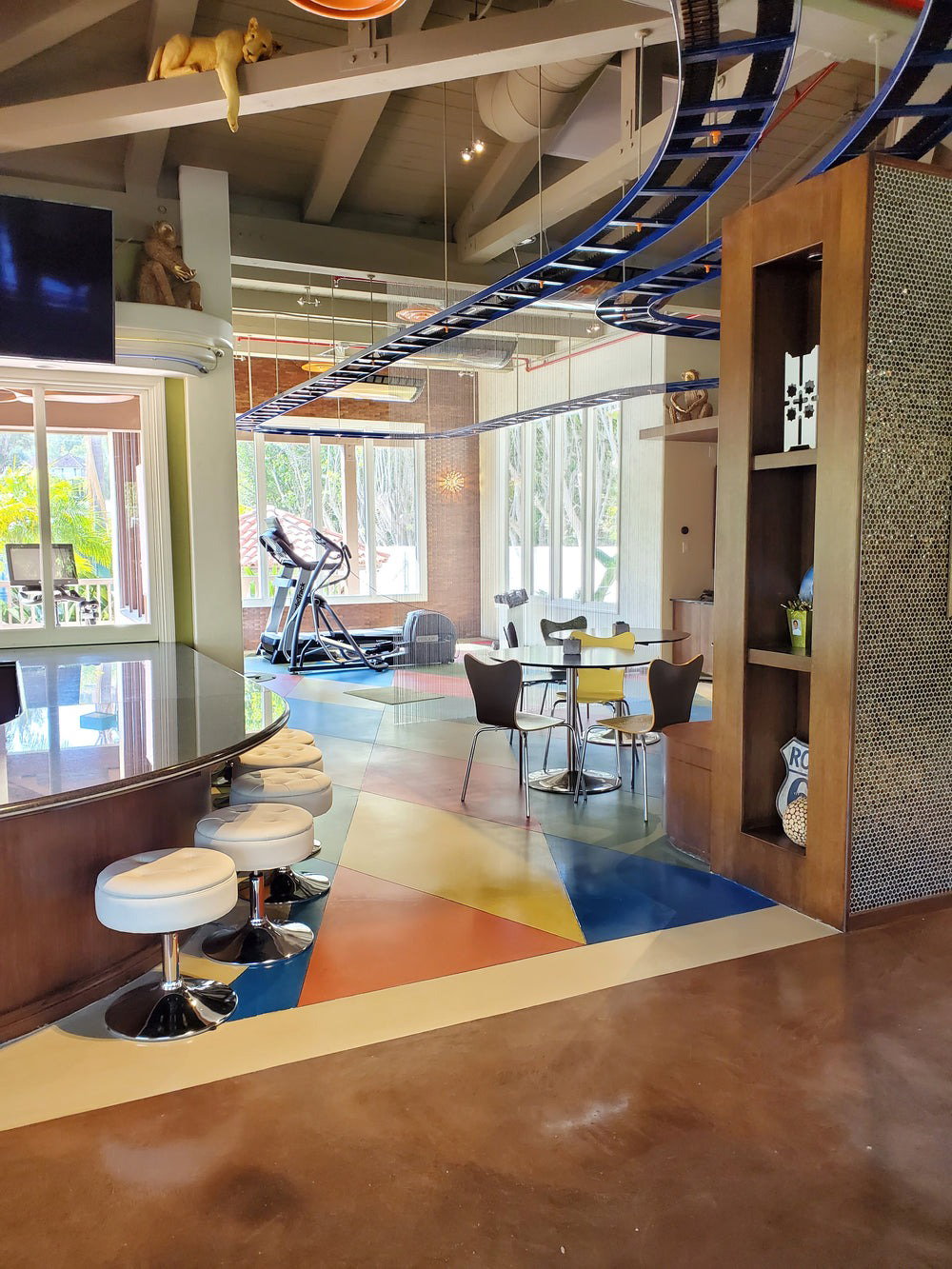
Orange County concrete staining
Concrete Contractor Services and Concrete Staining in Orange County, California
We do concrete staining for Orange County homeowners who want color in the slab instead of paint sitting on top. The work covers patios, driveways, pool decks, walkways, and interior floors from Mission Viejo to Newport Beach.
Most calls come from owners with a faded or tired slab who do not want to replace it. Staining is the cheaper, longer-lasting answer when the concrete is still sound.
years in construction and surface work
Google rating from local customers
California contractor license
Google reviews
Trust has to show up before the estimate.
5.0
Google rating from local customers
17
Google reviews and counting
Victoria
Orange County
★★★★★
"Our kitchen counter was pitted from water damage. Vince and Derrick fixed the granite and sealed everything at a reasonable price."
Google reviewJohn D.
Orange County
★★★★★
"Concrete patio, tile walkways, and driveway. Cleaning, patching, recoloring. Three days, and they aced it all."
Google reviewJudi Harris
Orange County
★★★★★
"Honest, hard working. Vince and Gio were punctual, neat, and surpassed our expectations."
Google reviewFrank Warren
Laguna Niguel
★★★★★
"Driveway was getting cloudy and chipping. Vince came out multiple times and even made a video showing me how to maintain it."
Google reviewMike Porter
Orange County
★★★★★
"Competitive quote, owner was hands-on the entire time, fixed every detail we pointed out."
Google reviewLaurie C.
Orange County
★★★★★
"Concrete restored and stained. Vince and his crew were professional, reliable, and always on time."
Google reviewMission Viejo location
Concrete Staining from a local Orange County crew.
We are based at 23881 Via Fabricante, Suite 521 in Mission Viejo. Most concrete staining work happens nearby in Lake Forest, Laguna Niguel, Rancho Santa Margarita, Irvine, Newport Beach, San Clemente, Tustin, and homes across Orange County.
Read the Google reviews on this page before you decide who should look at your surface.
What we do
What concrete staining does for an Orange County slab.
Acid stains react with the lime in the concrete and give a mottled, natural look in earth tones. Water-based stains soak into the pores and give a more even color in a wider range.
Either way, the color lives inside the slab. Sealer on top protects it from sun and traffic and gets recoated on a normal cycle.
The difference
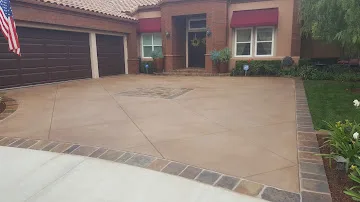
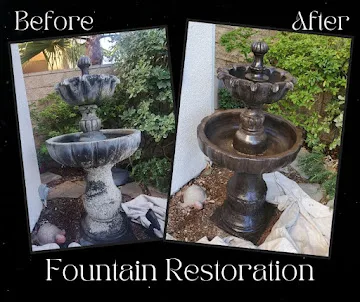
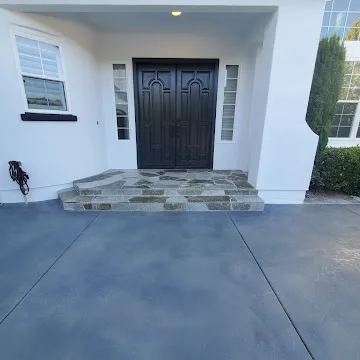
Stained concrete on driveways, patios, and front entries across the county.
We pick acid or water-based stain based on the slab, the look you want, and how the area gets used.
Sealer is matched to sun exposure, foot traffic, and whether the surface gets wet.
If the driveway also has old oil marks or needs a clean-and-seal decision, see our concrete driveway staining and sealing service.
Learn your surface
The better you understand the material, the better it holds up.
Quick reads on how concrete staining actually works for orange county homes, before you spend money on the wrong fix.
Acid stain for natural variegated color
Water-based stain for even color
Diamond grind to open the pores
Stain mock-up before the full job
UV-stable sealer for outdoor slabs
Slip-resistant additive on wet areas
How we work
A clear plan before the machines come out.
01
Inspection, water test, and mock-up
We walk the slab and run a water drop test. If water soaks in quickly the pores are open and stain will take, if it beads the surface is sealed or power-troweled and needs more prep. We also check moisture and pH, because a slab reading too alkaline will delaminate sealer later no matter how well we apply it. Before we quote the full job we run a small test patch in the exact stain you're considering, because 'Coffee Brown' on one slab can come out closer to burnt orange on another.
02
Strip, diamond grind, and repair
Old sealers, paint, mastic, and power-troweled finishes have to come off or the stain can't reach the concrete. We open the pores with diamond grinding (power washing alone doesn't profile a troweled surface), and we run the grinders with HEPA-filtered industrial vacuums because concrete dust is a silica hazard. Cracks get cleaned and filled with a tinted polymer patch that takes stain at a similar rate to the surrounding slab.
03
Stain, dwell, and neutralize
Acid stain goes on with an acid-resistant sprayer, gets worked with a soft-bristle brush to control the reaction, then dwells on the slab. We neutralize with a baking soda solution and rinse until the pH reads right, because leftover acid eats the sealer bond weeks after the job looks finished. Water-based stains are sprayed in light coats, and on hot inland days we work early or use a retardant so the surface doesn't flash-dry into lap marks.
04
Seal and protect
Outdoor slabs get a UV-stable solvent-based acrylic in a satin or low-gloss sheen, not cheap water-based acrylic that yellows and clouds in OC sun. Interior floors get a urethane or epoxy topcoat for traffic resistance, or a wax for softer foot-traffic areas. Before we leave, we walk you through resealing intervals and which cleaners to avoid. Vinegar, citrus, and ammonia all eat the sealer over time.
Orange County homes
Concrete staining for Orange County homes.
Coastal slabs in Newport Beach, Laguna Beach, and San Clemente need a sealer built for salt air. Inland slabs in Yorba Linda, Anaheim Hills, and Tustin need scheduling around hot afternoons so the stain reacts cleanly.
We work HOA neighborhoods in Ladera Ranch, Rancho Santa Margarita, Aliso Viejo, and Mission Viejo where earth-tone acid stain reads as natural and approves easily.
Questions
Straight answers before the estimate.
What's the difference between acid stain, water-based stain, and concrete dye?
Acid stain reacts chemically with the lime in your slab and gives mottled, variegated earth tones with natural variation. Water-based stain is a pigment that soaks into the pores and gives a more uniform color in a much wider palette. Dye is a finer-particle pigment used mostly on polished concrete for vivid color and sharp detail work.
Will the acid stain look exactly like the sample?
No, and that's the honest answer. Acid stain is a chemical reaction with your specific slab's mineral composition, so concrete age, porosity, calcium content, prior sealers, and even weather during application all change the result. 'Coffee Brown' on one slab can come out closer to burnt orange on another, which is why we always do a test patch on your actual slab before quoting.
How long does stained concrete last?
The stain itself is permanent because it's bonded into the concrete. The sealer on top is the sacrificial layer and wears down with traffic and sun, needing a recoat on a regular interval on driveways and patios in OC sun. Interior urethane topcoats go longer between maintenance because they're not fighting UV every day.
Is stained concrete slippery when wet?
The stain itself isn't slippery, but a glossy sealer can be when wet. We don't use high-gloss sealers on pool decks, shower floors, or entries that see rain. On any wet area we mix an anti-skid additive (shark grip polymer or fine glass beads) into the sealer so the finish stays grippy.
Can you stain my old, cracked driveway?
Yes, but know that stain highlights cracks rather than hiding them. With acid stain, hairline cracks often blend into the variegated pattern and read as character; wider cracks get filled with a flexible polymer patch tinted to match, but they'll still be visible. If you want a 'like new' surface on a badly worn slab, we pour a thin microtopping first so the stain has a clean, uniform canvas.
How long does the whole project take from start to finish?
Timing depends on slab size, stain type, and weather. Day one is usually prep and crack repair, day two is stain application, day three is sealer. We give you a day-by-day schedule at the free estimate so you know exactly when you can park on it or walk on it again.
What cleaners should I avoid on stained concrete?
Stay away from anything acidic: vinegar, citrus cleaners, and ammonia all etch the sealer and eventually reach the concrete underneath. Stick to a pH-neutral floor cleaner and a damp mop for routine cleaning. The sealer does most of the work protecting the color, so anything that eats the sealer is shortening the life of your finish.
How do I know if my slab can even be stained?
We use a water drop test during the walkthrough. If water soaks in quickly, the slab is porous enough to take stain. If it beads, the surface is sealed or too dense, and we have to diamond grind or chemically etch to open the pores before staining will work.
Related
Other concrete contractor services in Orange County.
Concrete Contractor
Concrete driveway staining
Concrete driveway staining and sealing in Orange County, with oil-stain cleaning for old or weathered driveways. Send photos for an honest estimate.
Concrete Contractor
Concrete sealing
Concrete sealing in Orange County, California for driveways, patios, pool decks, and garage floors. Penetrating and film-forming sealers matched to the surface. Send photos for an honest look.
Concrete Contractor
Concrete Resurfacing
Concrete resurfacing in Orange County, California for driveways, patios, pool decks, walkways, and garage floors. A new finish on the slab you already have.
Concrete Contractor
Concrete overlay
Concrete overlays in Orange County, California for patios, driveways, pool decks, garage floors, and decorative concrete. Skip tear-out and finish what you already have.
Concrete Contractor
Concrete Grinding
Concrete grinding in Orange County, California for floor prep, coating removal, leveling, and epoxy preparation. Garage, patio, and commercial slab work done right.
Concrete Contractor
Stamped concrete services
Stamped concrete in Orange County, California for patios, walkways, and driveways. Natural stone and brick patterns at concrete cost, finished and sealed.
Concrete Contractor
Driveway repairs
Driveway repairs in Orange County, California for crack repair, resurfacing, and full driveway restoration. Stop the cracks before they spread into a tear-out.
Have a concrete staining project you are not sure about?
Send a photo. We will tell you what we see and whether it belongs on our schedule.