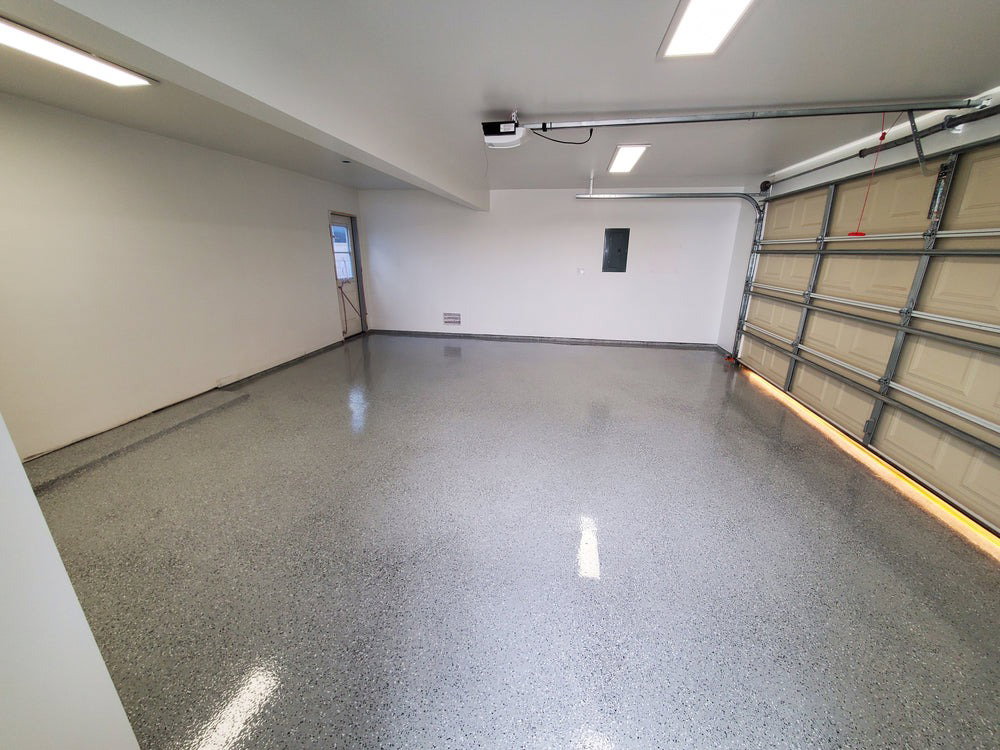
Orange County epoxy flooring
Floor Refinishing Services and Epoxy Flooring in Orange County, California
Certified for this work

Epoxy flooring is what we install when an Orange County garage, workshop, or showroom needs a sealed surface that holds up to oil, hot tires, and dropped tools. We diamond-grind the slab, lay a high-solids epoxy basecoat, and finish with a polyaspartic clear.
Most of our calls come from homeowners in Newport Beach, Coto de Caza, and Mission Viejo who tried a big-box kit and watched it peel inside a year. The fix is a real prep cycle and a coating system built for the way the slab actually gets used.
years in construction and surface work
Google rating from local customers
California contractor license
Google reviews
Trust has to show up before the estimate.
5.0
Google rating from local customers
17
Google reviews and counting
Victoria
Orange County
★★★★★
"Our kitchen counter was pitted from water damage. Vince and Derrick fixed the granite and sealed everything at a reasonable price."
Google reviewJohn D.
Orange County
★★★★★
"Concrete patio, tile walkways, and driveway. Cleaning, patching, recoloring. Three days, and they aced it all."
Google reviewJudi Harris
Orange County
★★★★★
"Honest, hard working. Vince and Gio were punctual, neat, and surpassed our expectations."
Google reviewFrank Warren
Laguna Niguel
★★★★★
"Driveway was getting cloudy and chipping. Vince came out multiple times and even made a video showing me how to maintain it."
Google reviewMike Porter
Orange County
★★★★★
"Competitive quote, owner was hands-on the entire time, fixed every detail we pointed out."
Google reviewLaurie C.
Orange County
★★★★★
"Concrete restored and stained. Vince and his crew were professional, reliable, and always on time."
Google reviewMission Viejo location
Epoxy Flooring from a local Orange County crew.
We are based at 23881 Via Fabricante, Suite 521 in Mission Viejo. Most epoxy flooring work happens nearby in Lake Forest, Laguna Niguel, Rancho Santa Margarita, Irvine, Newport Beach, San Clemente, Tustin, and homes across Orange County.
Read the Google reviews on this page before you decide who should look at your surface.
What we do
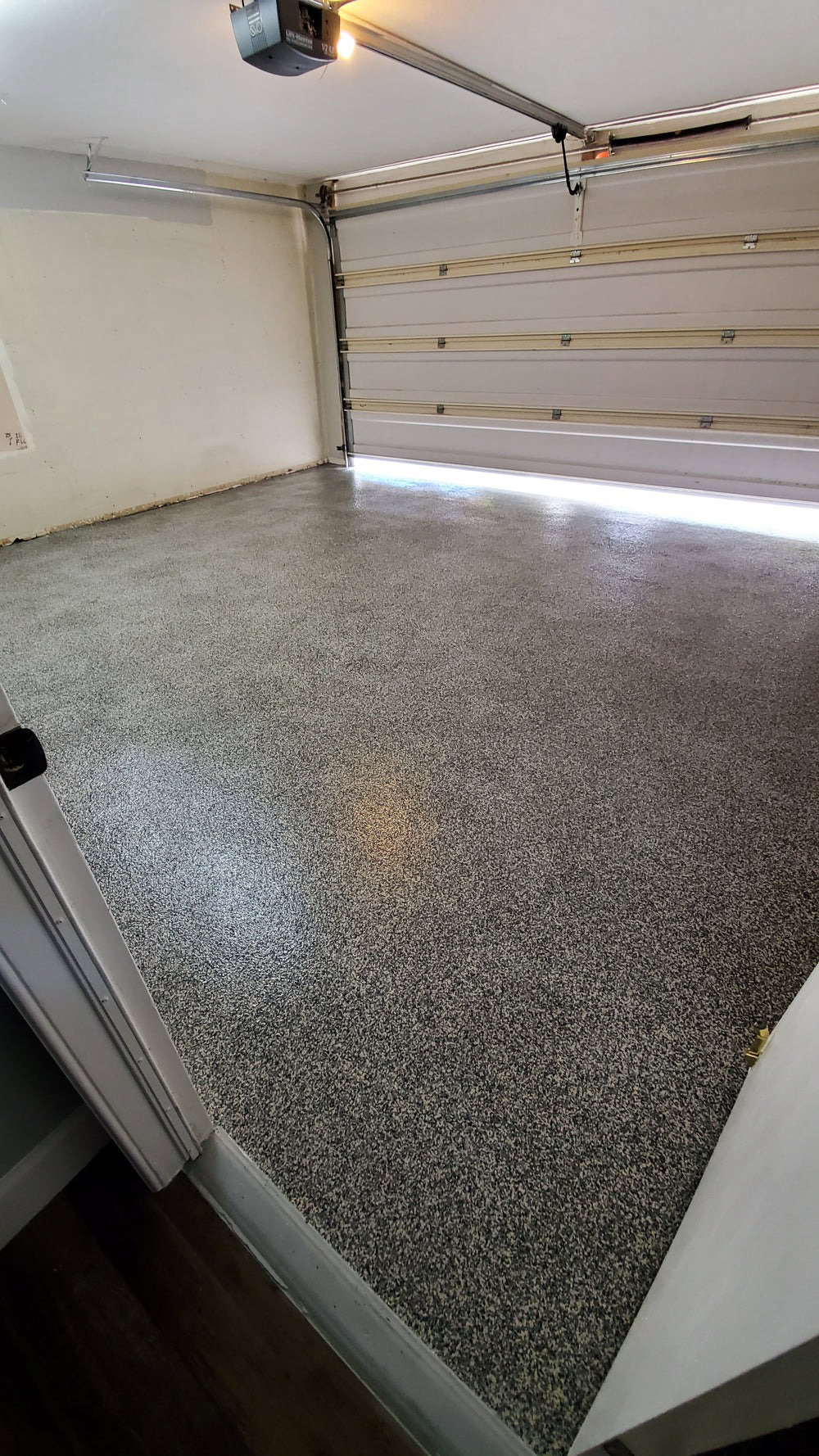
What real epoxy flooring looks like in an OC garage.
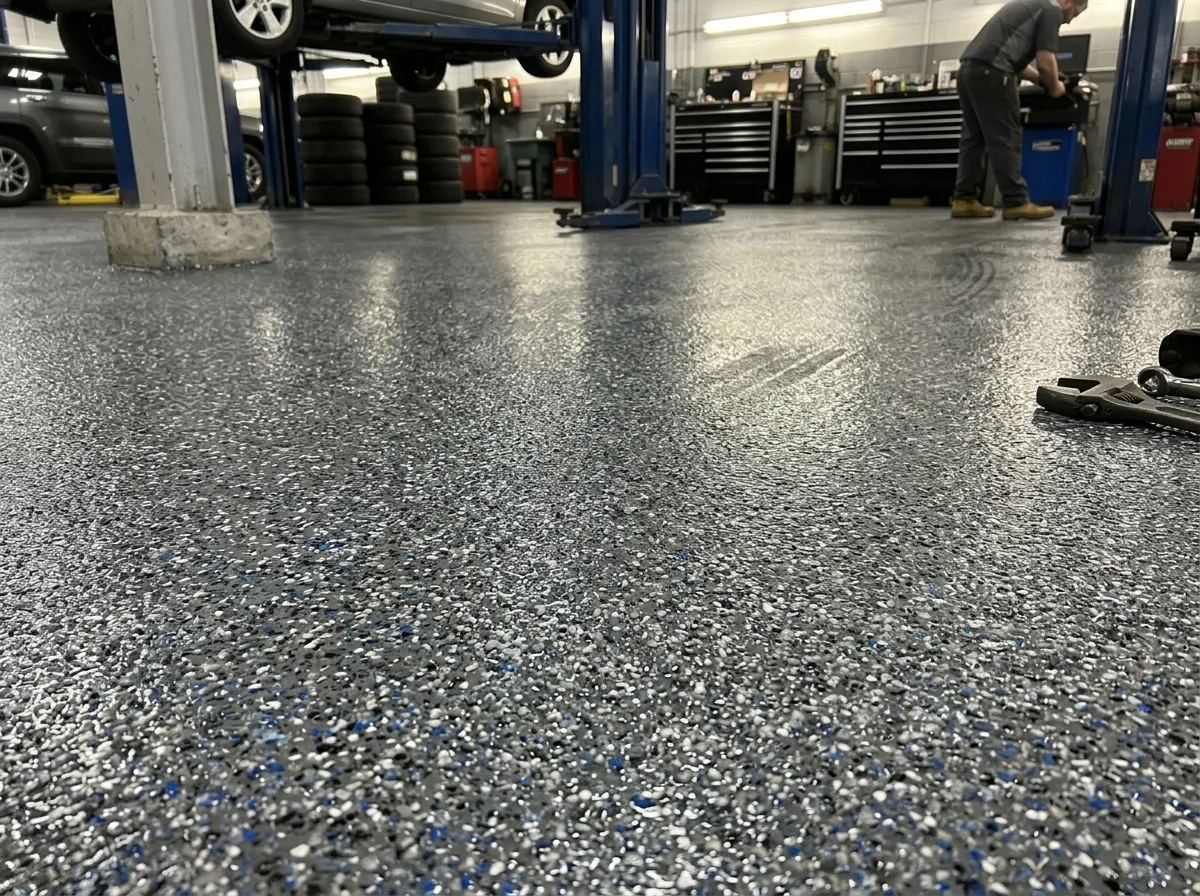
Epoxy is a two-part resin and hardener that cures into a hard plastic film bonded to the concrete. The film thickness on a real install is much thicker than what comes in a hardware-store kit.
The basecoat carries the color and the build, and a polyaspartic topcoat goes over it for UV stability, faster cure, and resistance to hot-tire pickup. Without that topcoat, summer driveways in Yorba Linda and Anaheim Hills will pull a coating right off the slab.
The difference
Read the slab before the resin comes off the truck.
Every garage tells you something different. Old paint, moisture coming up through the slab, hairline cracks across the floor, all of it changes what the prep needs to look like.
We grind the slab to a CSP-3 profile, repair cracks with polyurea, and run a moisture test before the basecoat goes down. Skipping any of those steps is what turns a long-lasting floor into one that fails fast.
Learn your surface
The better you understand the material, the better it holds up.
Quick reads on how epoxy flooring actually works for orange county homes, before you spend money on the wrong fix.
Diamond grind to a CSP-3 profile.
High-solids epoxy laid thick enough to bond.
Polyaspartic topcoat for UV and hot tires.
Flake or quartz broadcast for slip resistance.
Crack repair before any coating goes down.
Moisture testing on every slab.
How we work
A clear plan before the machines come out.
01
Measure
Slab, moisture, coating needs
02
Grind
Old coating removal, concrete profile
03
Coat
Crack repair, primer, flake broadcast
04
Cure
Final seal, cure, care notes
Orange County homes
Epoxy flooring for Orange County homes.
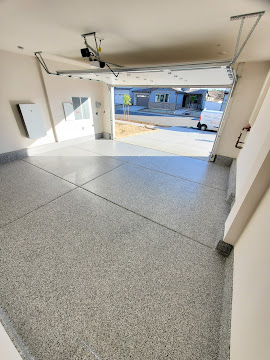
We coat residential garages from Newport Beach and Laguna Niguel to Lake Forest, Yorba Linda, and Anaheim Hills. Most of those slabs are older concrete with a mix of pitting, hairline cracks, and old paint.
Inland heat and coastal humidity each push a different system. Inland garages run hotter, so polyaspartic topcoats are non-negotiable. Coastal homes get more salt air, so the prep and seal cycle leans toward UV stability.
Questions
Straight answers before the estimate.
Why does the epoxy from Home Depot peel and how is yours different?
DIY kits are thin water-based epoxy applied over an acid-etched slab that never bonds properly. Our systems are high-solids epoxy laid thick over a diamond-ground slab with a polyaspartic topcoat. That's much more film thickness with a real mechanical bond and heat resistance.
Will it handle hot tire pickup?
Yes, when the topcoat is polyaspartic or polyurea. Hot tires bond to coatings that soften under heat and pull the coating off in tire-shaped patches when you back out. Polyaspartic stays rigid under high heat, so the tire releases cleanly and we've never had a callback on a polyaspartic-topped system.
Polyaspartic vs epoxy, which one do I want?
Most of our installs use both. Epoxy as the basecoat for thickness and color depth, polyaspartic as the clear topcoat for UV stability and tire resistance. Full polyaspartic systems are available when you need to park on the floor the next day, but the build is thinner and costs more per square foot. For most residential garages, the hybrid epoxy plus polyaspartic system is the right answer.
How long does it actually last?
Properly prepped high-solids epoxy with a polyaspartic topcoat is a long-lifespan system in a residential garage. The wear point is the topcoat, which we can recoat down the road to extend the floor. Early failures we've seen are all prep shortcuts or skipped moisture tests, not coating failures.
Can you go over my old epoxy or paint?
Almost never, because new epoxy bonds to whatever's under it, including a coating that's already failing. Fresh epoxy over an old painted floor will lift the old one off the slab the first time it gets stressed. We diamond-grind old coatings off as part of standard prep, not as an extra.
Is the floor slip resistant when wet?
Smooth epoxy gets slick when wet, but flake and quartz broadcast systems have texture from the chips and stay slip resistant. For solid-color floors we can add aluminum oxide or polypropylene grit into the topcoat for traction without making the floor hard to clean. We ask about kids, pets, and how often the floor gets wet during the consult.
What about color choice and flake patterns?
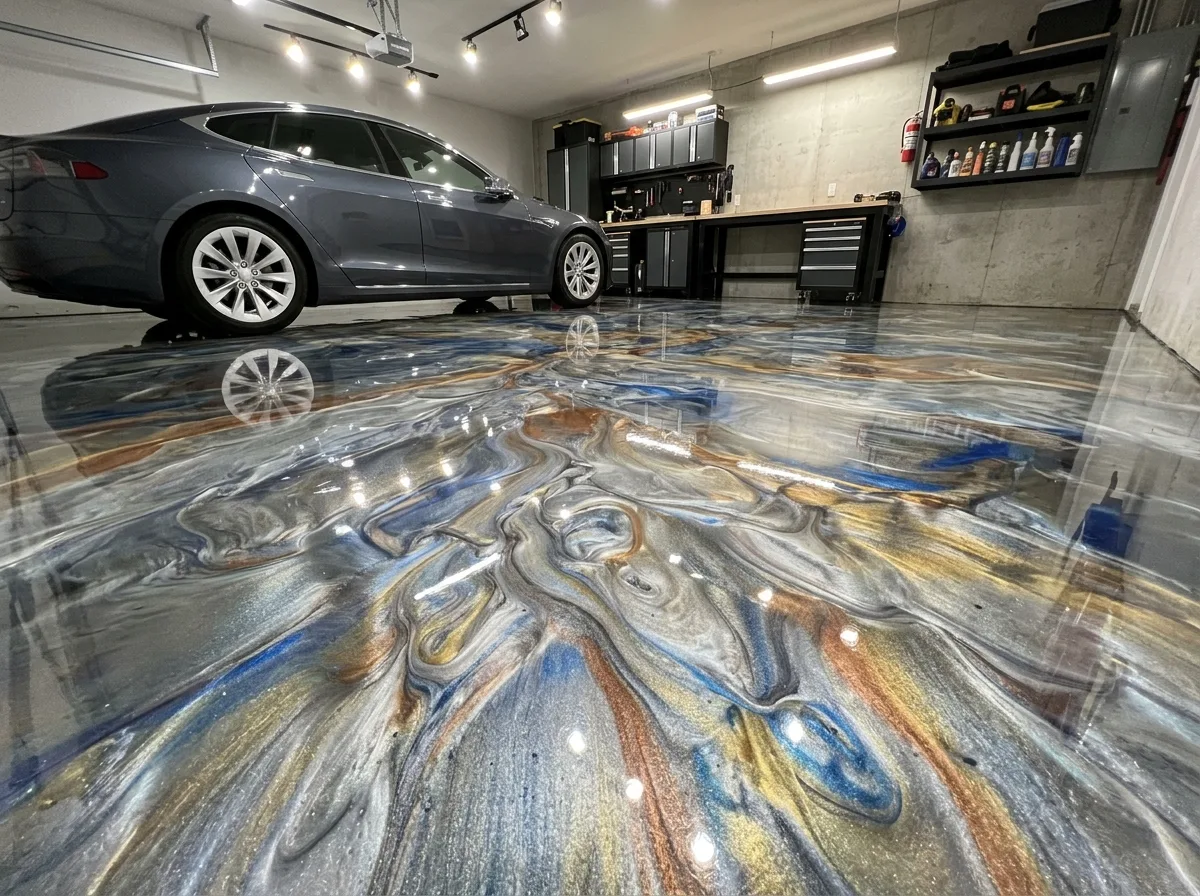
Solid colors come in any standard or custom RAL or Sherwin-Williams color, and flake systems use vinyl chips in many pre-blended combinations. Metallic epoxy mixes pearlescent pigments into the resin and we hand-trowel patterns before it sets, so every floor is unique. We bring physical samples to the walkthrough so you're not picking from a screen.
Related
Other floor refinishing services in Orange County.
Floor Refinishing
Garage Flooring
Garage flooring in Orange County, California for daily-use garages and workshops. Epoxy, polyaspartic, and polished concrete options that handle heat, oil, and weight.
Floor Refinishing
Stone Flooring
Stone flooring in Orange County, California for marble, travertine, limestone, and slate. Grinding, honing, polishing, and sealing without the cost of full replacement.
Floor Refinishing
Natural Stone Maintenance
Natural stone maintenance in Orange County, California for marble, travertine, limestone, and granite. Scheduled care that keeps stone surfaces out of restoration cycles.
Floor Refinishing
Deep Cleaning
Deep cleaning in Orange County, California for tile, stone, and grout. Stone-safe extraction for marble, travertine, saltillo, ceramic, and the grout in between.
Floor Refinishing
Floor Maintenance
Floor maintenance in Orange County, California with monthly and quarterly plans for homes and businesses. Scheduled care that keeps floors out of expensive restoration.
Floor Refinishing
Commercial Floor Maintenance
Commercial floor maintenance near me in Orange County for concrete, stone, tile, grout, offices, retail stores, restaurants, medical offices, showrooms, and property-managed buildings.
Have a epoxy flooring project you are not sure about?
Send a photo. We will tell you what we see and whether it belongs on our schedule.