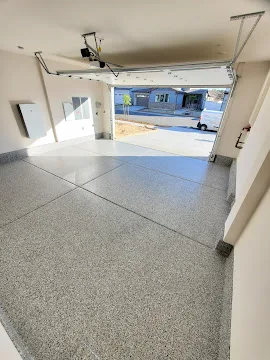
The Honest Answer: Yes, Under Four Conditions
Smooth, high-gloss epoxy gets slippery. That is not a defect in the material, it is how a hard resin film behaves once it cures flat and glassy. A smooth epoxy floor with nothing on it grips reasonably well. Add water, oil, dust, or soap, and it doesn’t. A garage floor collects all four in the same week: rain tracked in on tires and boots, oil or coolant drips, concrete dust and dirt from the yard, and a neutral-detergent mop pass to clean it. Pretending a coating is immune to that is not honest, and it’s not what this article is going to do.
The fix is not switching materials. It is choosing the right texture for how the space actually gets used, which is the part most articles on this topic skip.
Why a Smooth, Glossy Coating Loses Grip
Epoxy cures into a hard plastic film bonded to the concrete underneath it. Left smooth, that film has no microscopic texture for a shoe, tire, or bare foot to grab onto, and a thin layer of water, oil, or fine dust turns it into close to a frictionless plane. This is a named, expected property of the chemistry, not a manufacturing error. The same is true of a metallic epoxy finish, which gets its marbled look from pouring and manipulating pigment while the resin is still liquid: the surface that results is smooth and glossy by design, and it is genuinely one of the more slippery finishes available, not a middle-ground option.
Texture works by physically breaking up that smooth plane. Chips, sand, or grit sitting in or on the topcoat give a shoe sole something to catch on even when the surface is wet, the same reason a rough sidewalk grips better in the rain than polished stone.
How Slip Resistance Is Actually Measured
There is a real number behind this, not just marketing language. The floor-coatings industry generally works to ANSI A326.3, an American National Standards Institute benchmark that sets a minimum wet dynamic coefficient of friction (DCOF) of 0.42 for interior floors expected to get wet, with several use-classification tiers above that for wetter or greasier conditions. Two honest limits are worth knowing. It is an industry-consensus benchmark, not a federal law, and no single test method has universal agreement, wet-DCOF testing, pendulum testing, and ramp testing are all still in use across the trade. And a coefficient-of-friction number describes a lab measurement of a sample, not a guarantee about a specific installed floor years into its life with wear, grease, or the wrong cleaner on it. Treat it as a useful reference point for the conversation with a contractor, not a number to chase for its own sake.
The Traction Options, Ranked With Their Trade-Offs
Every texture option adds grip at some cost. None of them is free, and the honest version of this list says what you give up with each one.
Vinyl flake broadcast. Colored chips are broadcast across the wet basecoat, from a light partial scatter up to a full “broadcast to rejection” where the surface can’t take another chip. Flake adds real texture and does a genuinely useful second job, hiding minor surface inconsistencies and everyday dirt between cleanings. The cost is that a fuller broadcast has more surface area and more edges for grit to sit in, which means more attention with a broom or shop vacuum to keep it from feeling gritty underfoot.
Quartz broadcast. Colored quartz sand goes down the same way flake does, and it holds up to heavier wear, which is why it shows up on commercial and industrial floors as often as residential garages. It grips well and wears slowly. The trade-off is similar to flake: more texture on the floor means a mop takes more effort to pull clean, and a very heavy quartz broadcast can start to feel almost sandpaper-rough underfoot, which some homeowners like in a workshop and don’t want in a living space.
Aluminum oxide and polymer-bead additives. Instead of broadcasting a full layer of chips, a contractor can stir a graded traction additive directly into the clear topcoat, or apply it as a light dusting into the final coat. This is the way to add real grip to a solid-color or lightly textured floor without changing its look much, and it comes in graded sizes, coarser grit for more bite, finer grit for a subtler texture. Cleaning is easier than a full flake or quartz floor since there’s less surface texture overall, but a fine additive alone won’t match the grip of a full broadcast in a genuinely wet, high-traffic zone.
Metallic pigment: not a traction option. Worth naming directly: a metallic epoxy finish is a decorative choice, not a traction choice. It is smooth and glossy by design, which is exactly what gives it the marbled, poured-glass look homeowners choose it for, and that same smoothness makes it one of the more slippery finishes on this list. A metallic floor can still get a traction additive worked into its clear topcoat, but the floor itself does nothing for grip on its own.
How Much Broadcast Density Actually Changes
This is the part that gets skipped in most explanations of texture options: broadcast density is a spectrum, not an on/off switch, and moving along it changes both the look and the grip of the floor at the same time. A light, partial flake scatter reads almost like a solid color with a bit of visual interest, and it adds modest traction. A full broadcast to rejection reads as a genuinely stone-like, heavily textured surface, and it adds meaningfully more grip. Neither end is automatically correct. A full broadcast that’s overkill for a dry, occasional-use guest parking spot becomes genuinely harder to keep clean, with more mop drag and a flatter, less glossy look, for traction the space didn’t need in the first place. The right call is matching density to how wet, oily, or high-traffic that specific area actually gets, not defaulting to the heaviest broadcast available because more texture sounds safer. That’s the whole idea behind treating texture as an application decision instead of a more-is-better spec, and it’s one piece of the larger epoxy, polyaspartic, or polished concrete decision for a garage floor.
If Your Existing Floor Is Already Slippery
A floor that’s already installed and reading as too slick is not automatically a full tear-out. Traction is something a coating system can pick up later the same way it’s specified at install, through a grit-loaded clear recoat over the existing surface. The judgment call that belongs to a professional walkthrough, not a DIY guess, is whether the existing floor needs a light mechanical profile first. A quick wipe-down or pressure wash cleans the surface but does not create a new bonding profile, so a recoat applied straight over an untouched glossy floor risks not adhering the way it’s supposed to. This is also a case where adding more grit isn’t automatically the answer if the real problem is a specific wet or oily zone rather than the whole floor, which is why the next section matters as much as the additive choice itself.
Specify Traction by Area, Not the Whole Floor
A garage, a covered walkway, and a pool-adjacent patio slab don’t need the same amount of grip, even when they’re all epoxy or a related coating system, and a good spec treats them differently instead of applying one texture everywhere.
- Parking lanes stay dry most of the time, with occasional wet or oily moments from rain, washing, or a drip. A moderate flake or additive level is usually enough here without turning daily foot traffic into a cleaning chore.
- Walkways and entries see tracked-in water routinely, every rainy day and every pool day, which puts them closer to the higher end of the traction range regardless of how dry the rest of the space stays.
- Laundry rooms and pool-adjacent areas are wet or soaped down as a matter of routine, not an occasional event, which makes them the priority zone for the heaviest practical traction the coating system allows. A polyaspartic topcoat is often the right chemistry choice in these zones for its fast cure and UV stability, a separate but related decision from the traction additive itself, covered in more depth once a dedicated polyaspartic breakdown is live on the site.
None of this is an exotic request. It’s the kind of question a contractor who actually thinks about how a space gets used should be asking before the first coat goes down, not something the homeowner has to bring up first.
What Happens Next
Getting slip resistance right on an epoxy floor is a spec decision made before the first coat goes down, or a recoat decision made carefully on an existing floor, not a guess. We are a Westcoat-approved applicator for the Epoxy Coat system, and matching broadcast type, density, and additive to how a specific garage, entry, or pool-adjacent space actually gets used is a walkthrough decision, not a one-size answer applied to the whole floor. If you’re weighing texture options for a new install or wondering whether an existing floor can be made safer without starting over, the epoxy flooring page covers the full system, from prep through topcoat.