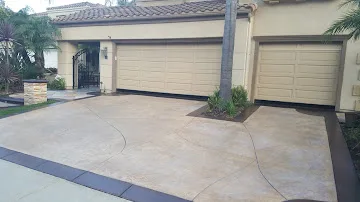
A driveway or patio that was clear and glossy a week ago and is now milky, gray, or blotchy usually comes down to one thing: moisture or solvent got trapped in the sealer while it was curing. What changes case to case is why, and what it actually takes to fix it.
The short answer
Concrete sealers, at least the acrylic ones used on most Orange County driveways, patios, and pool decks, work by forming a thin film on top of the slab. That film is supposed to cure clear. If moisture, or in the case of a solvent-based product, solvent, gets trapped inside that film instead of escaping cleanly while it sets, the film hardens around the trapped material rather than around clear resin. Light hits that trapped moisture or solvent and scatters instead of passing through. What you see is a milky white haze, a gray cloudiness, or blotchy pale patches instead of a clean, clear finish.
It isn’t dirt. It’s usually not a bad batch of sealer either. It’s physics: something got caught inside the film on its way to curing.
Water-based and solvent-based sealers don’t fail the same way
This distinction matters more than almost anything else here, because it decides which fixes are even possible later on.
A water-based acrylic sealer cures through a process called coalescence. It goes on as an emulsion, tiny resin particles suspended in water. As the water evaporates, those particles fuse together into one continuous film. It’s a physical merging, not a chemical bond between particles and a solvent.
A solvent-based sealer works differently. The resin is fully dissolved in a solvent carrier. As the solvent flashes off and evaporates, the dissolved resin is left behind as the film. That resin was never broken into separate particles the way it is in a water-based emulsion. It was in solution the whole time.
Here’s why that matters: a solvent-based film can sometimes be re-softened later by the right compatible solvent, because the resin was never permanently cross-linked. Under the right conditions it can go back into a semi-liquid state and then re-cure. A water-based film that has already coalesced doesn’t have that option. There’s no shared solvent carrier to melt it back down on command. That single difference is why a lot of the fix-it advice floating around online falls apart once you know which sealer is actually on your slab.
The full list of what causes it
Whitening and cloudiness rarely have a single cause. This is the complete list of causes:
- Sealing over a slab that wasn’t fully dry. Moisture already present in or on the concrete gets sealed in before it has a chance to leave.
- Rain arriving before the film cured. Even a light shower can introduce enough water to disrupt a film that hasn’t set yet.
- Applying too much material in one coat. A heavier film takes longer to cure all the way through, which gives moisture or solvent more time and more material to get trapped in.
- Multiple heavy coats without enough time between them. Each coat needs to flash off before the next goes on. Stack coats too fast and the lower layer can trap material under the layer above it.
- Cold temperatures. Cold slows evaporation and coalescence, stretching out the window during which the film is vulnerable to trapped moisture.
- High humidity. Same effect as cold, from the air side instead of the surface side. Moisture struggles to leave the film when the surrounding air is already saturated.
- Sealing over old or different sealer chemistry. An incompatible recoat, especially over a sealer with unknown history, can trap material at the boundary between the old and new layers instead of forming one continuous film.
- Solvent entrapment. This one is specific to solvent-based products applied too thick or too fast. The solvent can’t flash off cleanly through the thickness of the film, so it gets caught underneath the curing surface.
These causes rarely show up alone. A slab sealed a little too heavy, on a morning that was a little too humid, is a common combination.
Sealing too early on a coastal Orange County morning
This one gets its own section because it’s specific to where we work, and because it’s the cause homeowners are least likely to connect to the problem.
Orange County mornings near the coast frequently carry a marine layer, that overcast, damp air that sits over the coastline before burning off later in the day. A slab can look and feel dry to the touch and still be sitting below the dew point. That means microscopic condensation is forming on the surface even without any visible moisture. To a curing sealer, that condensation behaves the same way rain or a damp slab does. It’s water in the wrong place at the wrong time, and it gets trapped in the film exactly like any other source of moisture on the list above.
This isn’t the only cause, and it isn’t always the cause. A slab sealed on a dry, inland afternoon can whiten just as easily from overapplication or a cold snap. But for a slab sealed early in the morning near the coast, before the marine layer has cleared and before it has warmed above the dew point, this is a real and often overlooked contributor. Watching the rain forecast isn’t enough by itself. The surface condition of the slab at the moment of application is what actually matters.
Why “just spray xylene on it” is dangerous advice
If you’ve searched this problem online, you’ve probably run into a video or two showing someone spraying a solvent, usually xylene or acetone, onto a hazy sealer and wiping the cloudiness away. That technique is real, and it does work in the right circumstances. The problem is that almost none of those videos tell you what those circumstances are.
Solvent reactivation works on a solvent-based sealer because, as covered above, that resin was never cross-linked. The right solvent can re-soften the surface layer, let the trapped material redistribute or escape, and allow the film to re-flash clear. It doesn’t work the same way on a water-based sealer, because a water-based film cured through particle coalescence, not through a solvent bond that another solvent can undo. Spraying solvent on a water-based sealer that’s already whitened from trapped moisture doesn’t address the moisture that caused the problem in the first place. At best it does nothing. At worst it introduces a chemical to a surface and a chemistry it was never designed to interact with, on top of a moisture problem that’s still sitting there underneath.
There’s a safety side too, and it’s the part a five-minute tutorial usually skips entirely. Solvents like xylene and acetone are flammable, need real ventilation, and aren’t something to spray around freely, especially close to a home. Before reaching for a solvent, it’s worth knowing for certain which sealer chemistry is actually on the slab. If that isn’t obvious from a receipt or a memory of what was used, it’s a reasonable thing to have someone look at in person rather than guess.
When reactivation works, and when the sealer needs to come off completely
There are really two paths once you know what you’re dealing with.
Reactivation is worth attempting when the sealer is solvent-based, the haze is recent, and it’s a surface-level problem rather than something set in deep. Under those conditions, the right compatible solvent, applied correctly, has a real chance of clearing the cloudiness without removing the whole film.
Full removal and a fresh, compatible recoat is the realistic answer in a few situations: the sealer is water-based, the cloudiness has already been through multiple wet-dry or hot-cold cycles, a reactivation attempt didn’t clear it, or the whitening shows up alongside other problems like delamination, peeling, or uneven gloss. Those additional symptoms usually mean the issue has moved past a surface appearance problem into a bond failure. No amount of solvent wiped across the top is going to fix a film that’s separating from the concrete underneath. At that point the sealer needs to come off, the slab needs to be reassessed, and a new, compatible system needs to go back down.
There isn’t a shortcut that applies to every driveway. What decides the right path is the chemistry on the slab and how long the problem has been sitting there.
What this isn’t: whitening versus efflorescence
One more distinction is worth making before you assume you know what you’re looking at. Efflorescence is a different problem that also shows up as white residue on concrete, sealed or not. It happens when water moves through the concrete carrying dissolved salts with it, then evaporates at the surface and leaves those salts behind as a powdery or crystalline deposit. That’s a moisture-and-substrate issue, separate from a sealer film trapping moisture or solvent while it cures. Wiping away the salts without addressing the moisture source behind them just brings the deposit back. If what you’re seeing looks powdery or crystalline rather than milky or cloudy, you may be looking at efflorescence instead of a sealer failure, and that calls for a different conversation.
What to do next
Two questions decide almost everything here: which sealer chemistry is actually on your slab, and how long has the haze been sitting there. Get those two answers right and the rest of it, reactivate or strip, DIY-safe or not, mostly sorts itself out. When a phone photo isn’t enough to settle either question, an in-person concrete sealing assessment is how we work out the chemistry and the timeline before recommending a fix.