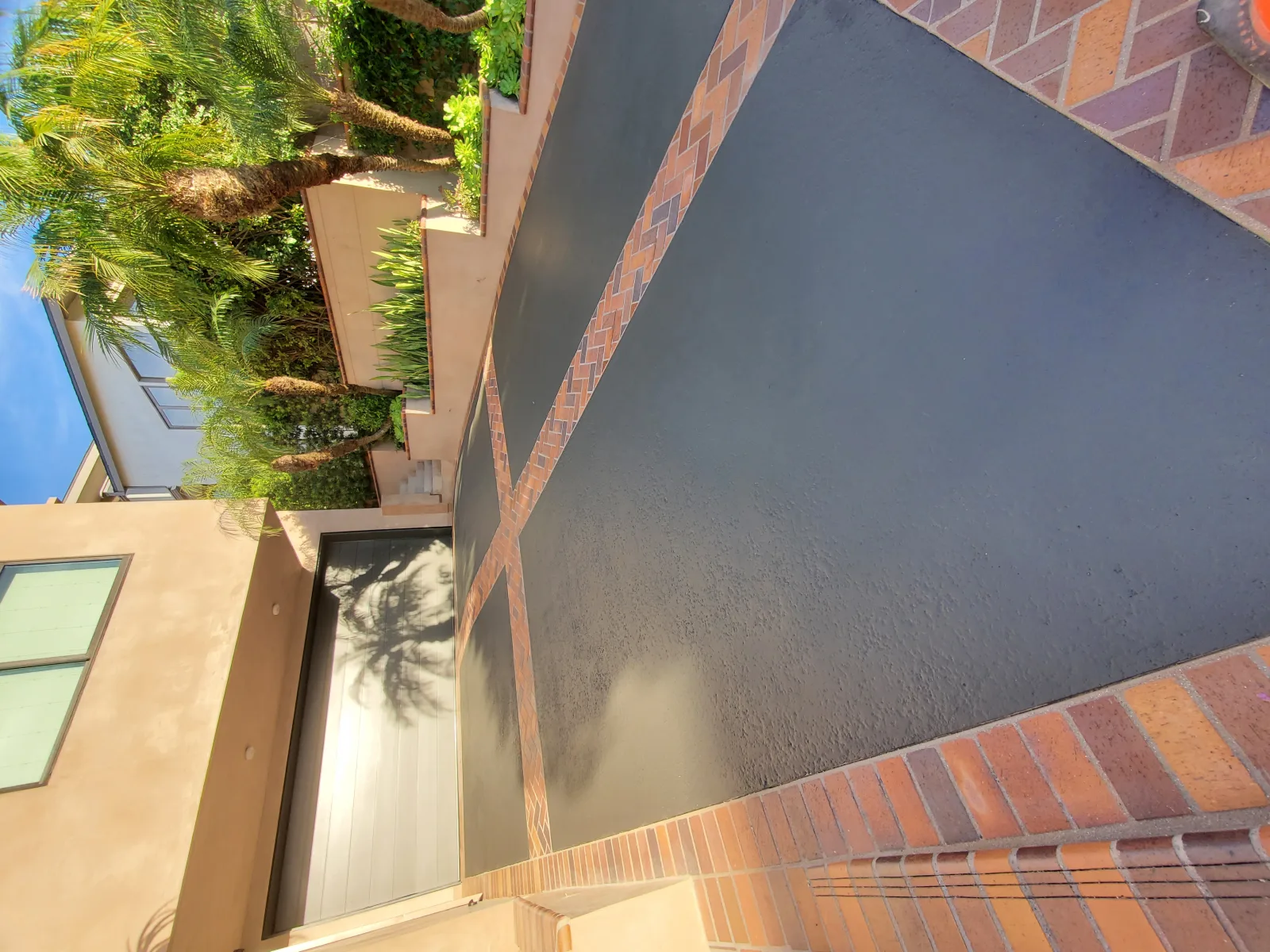
You had the patio or driveway resurfaced. The old cracked, stained slab turned into something you actually liked looking at. Then, a few months or a couple of years later, a thin line shows up in almost the exact same spot the old crack used to be. It’s easy to assume the overlay failed. Most of the time, that’s not what happened.
Your Overlay Didn’t Fail: Your Slab Told You Something
A concrete overlay bonds to your existing slab two ways. The material locks mechanically into a surface that’s been ground to the right profile, and it hardens into its own hard mineral layer as it cures. Both of those things happen at the surface. Neither one changes what the concrete underneath is doing.
That’s the part that surprises people. An overlay is a finish, not a structural repair. If the original slab has a crack that’s still moving, or an expansion joint that’s supposed to move, the overlay sitting on top of it is along for the ride. It can delay a crack from showing, and in some cases hide it for a long while, but it doesn’t have the strength to override what the base concrete is doing. When that crack finally shows through the new surface, contractors call it reflection cracking, because the old crack is essentially reflecting up through the new layer.
None of this means the job was done poorly. It usually means the slab had a crack that was going to move regardless of what got installed on top of it, and the honest version of that conversation should have happened before the material went down, not after.
Crack, Control Joint, or Expansion Joint? Most Homeowners Can’t Tell
Here’s where a lot of confusion starts. Not every line in concrete is a crack, and treating them all the same way is how avoidable problems get created.
A crack is an unplanned fracture. It can be caused by shrinkage as the concrete cured, ground settlement, temperature swings, moisture, or an actual structural issue. Cracks can be dormant, meaning they’re not moving anymore, or they can still be active.
A control joint (sometimes called a contraction joint) is put there on purpose. When a slab gets poured, a straight line is tooled or saw-cut into it in a planned pattern. That’s a deliberate weak point, engineered so that when the concrete inevitably shrinks a little as it cures, it cracks along that clean line instead of splitting randomly across the middle of your patio. A control joint doing its job looks like a straight, evenly spaced line. It’s not a defect. It’s the slab behaving the way it was designed to.
An expansion joint (also called an isolation joint) is different again. You’ll usually find these where your driveway meets the garage slab, where a patio meets the house foundation, or around the edge of a pool deck. These joints exist so two separate pieces of concrete can expand and contract independently without pushing against each other and cracking. An expansion joint needs a flexible sealant, and it needs to stay flexible. It cannot be filled with something rigid.
If you’re standing on your patio trying to figure out which one you’re looking at, the general rule is this: a straight, tooled or saw-cut line that runs in a clean pattern is probably a control or expansion joint doing exactly what it’s supposed to do. A jagged, irregular line that doesn’t follow any obvious pattern, especially one that’s growing, is more likely an unplanned crack. That distinction changes everything about how it should be treated, which is the whole reason this article exists.
Is Your Crack Moving, or Is It Dormant? How a Pro Figures That Out
Once you know you’re looking at an actual crack and not a joint, the next question is whether it’s still moving. This is the step that gets skipped more often than any other, and skipping it is a major reason reflection cracking happens at all.
A few things point toward ongoing movement: the crack keeps getting a little wider or longer over a period of weeks or months, it lines up with a spot where you’d expect movement anyway (an apron, a slab-to-foundation edge, a transition next to a pool deck), or it shows rust staining, fine debris, or damp marks along the line. A crack that reopens in the same spot after it’s already been patched once is telling you something, too. Sharp, clean edges on a fracture often mean it’s recent or still active.
Dormant cracks tend to look more settled. The edges have weathered a bit, the width hasn’t changed across repeat visits, and there’s no correlation to an obvious movement source nearby.
The reliable way to tell the difference is watching it over time, not eyeballing it once. A contractor might mark the ends of a crack and come back in a few weeks, or use a small gauge that records movement directly. You can do a version of this yourself before you ever call anyone: take dated photos, put a pencil line at each end of the crack, and check back in a couple of weeks to see if it’s grown past your marks. That’s genuinely useful information to have ready, and it costs you nothing. What it doesn’t replace is a professional look at whether the crack ties into a structural issue, a settlement problem, or something else that needs to be addressed before any new surface goes over it.
The Honest Strategy List for a Crack That Might Reflect Through
There’s no single trick that makes reflection cracking a non-issue. What exists instead is a set of real strategies, used in combination depending on what the diagnosis actually shows:
Repair static cracks first. A crack that’s confirmed dormant can often be stabilized with a low-viscosity epoxy injection or a rout-and-fill repair before the overlay goes on, giving the new surface a sound base to bond to instead of an unaddressed fracture.
Use a flexible membrane where the situation calls for one. Certain crack-isolation membranes go down between the slab and the overlay specifically to absorb some movement before it reaches the new surface. It’s not needed on every job, only where a joint or repair line still needs some give beneath the new surface.
Cut new decorative joints that honor the pattern already in the slab. If the original concrete has control joints, the new surface should follow that same layout rather than pretending the joints aren’t there. Fighting the existing joint pattern is asking for trouble.
Isolate known movement instead of bridging it. Anywhere the slab is designed to move, like an expansion joint, that movement needs to stay isolated with a flexible sealant rather than getting locked down by a rigid overlay system running straight across it.
Accept controlled reflection where it’s the honest answer. Sometimes, even after doing everything right, a very thin decorative layer over a known joint can eventually show a faint line. That’s a known tradeoff of a thin system, not the same thing as the job failing.
Which combination applies depends entirely on what’s actually under the slab. This is also where a fair conversation about concrete overlay work should start: repair and joint treatment come before color and pattern get discussed, not after.
The one thing worth being direct about: no thin decorative layer can guarantee a moving crack never shows again. Anyone telling you otherwise is promising more than the material can deliver.
Why Rigidly Filling an Expansion Joint Guarantees the Crack Comes Back
This is the single most common way a “repair” backfires, and it’s worth explaining exactly why it happens instead of just stating it.
An expansion joint exists so two slabs, or two sections of the same slab, can move independently as temperature and moisture change. When someone fills that joint with a rigid material, whether it’s a hardware-store crack filler, mortar, or an epoxy that bridges straight across the gap, that filler has no ability to flex. The joint underneath it is still going to move, because that’s what it was built to do. The rigid material can’t move with it, so it cracks again, usually right along the same line, and sometimes it pulls a strip of the new overlay with it.
This isn’t a rare or unlucky outcome. It’s one of the most common, best-documented causes of overlay and coating failure, and it happens because a rigid material got asked to do a flexible joint’s job.
What a Trustworthy Overlay Quote Should Say About Your Cracks
Before you agree to any material, pattern, or color for a resurfacing job, a straightforward contractor should be able to walk you through a few things:
- Which cracks were actually inspected, and whether each one reads as dormant or still moving.
- Which control and expansion joints exist in your slab, and whether the new work will honor those joints or requires new decorative cuts.
- Specifically what happens at each expansion joint. It should be isolated, not bridged.
- Which overlay system is being proposed and why it fits what was found during inspection, not just what looks good in a photo.
- A plain statement that a thin decorative layer can’t promise a moving crack will never show again.
If a quote skips straight to talking about color and finish without ever mentioning the cracks and joints already in your slab, that’s the step that actually determines whether the job holds up, and it got skipped.
Our crew’s ARDEX Engineered Concrete Repair Systems training covers exactly this kind of diagnosis and repair sequencing before a topping goes down. We’re straightforward that it’s training completed, not a lifetime guarantee against every possible outcome, because that’s the honest way to describe it.
If your situation points toward a moving or structural crack rather than a cosmetic line, that’s concrete repair and restoration work first, before any decorative system gets discussed. Fixing the cause matters more than picking a finish.