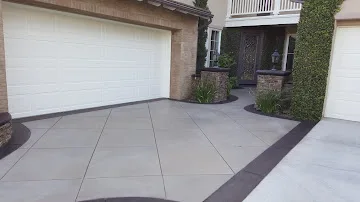
Search “polished concrete vs epoxy” and most of what comes back declares a winner. One page says epoxy wins because it hides more. Another says polished concrete wins because there’s nothing to peel. Both are true in the right room and false in the wrong one, which is the actual problem with treating this as a single question with a single answer.
The better question is narrower: given this specific slab, this specific room, and how you’re actually going to use it, which system matches? That answer changes between a garage, a kitchen, and a workshop, and it changes again depending on what’s happening under the concrete before either system ever touches it.
What’s Actually Different, Not Just What They Look Like
Before comparing how they perform, it helps to understand what each one actually is, because the difference explains almost everything that follows.
Polished concrete isn’t a coating. It’s the existing slab, ground down in stages with diamond tooling, densified, and honed to a finish. There’s no applied layer sitting on top of the concrete waiting to separate from it. The industry distinction here (polished concrete as mechanically refined concrete rather than surface-coated concrete) comes from the American Society of Concrete Contractors, and it’s the reason polished floors don’t peel: there’s no bond line between “floor” and “coating” for anything to fail at.
Epoxy is the opposite kind of system. It’s a resin and hardener that cure into a plastic film bonded to the slab, and that bond is the whole game. The film attaches through mechanical interlock into a ground profile and through adhesive chemistry. That’s why proper diamond grinding matters as much as the resin itself. Skip the profile, leave old sealer or oil on the slab, and the strongest epoxy on the market still has nothing solid to grab onto.
That single distinction, refined-in-place versus bonded-on-top, is what drives the rest of this comparison. Everything downstream, how each one fails, how each one gets maintained, how each one behaves over a damp slab, traces back to whether there’s a bond line to worry about or not.
What Each One Actually Looks Like
Polished concrete has a real range, not one look. Grinding stops at different depths, and each depth exposes something different: a “cream” finish leaves the original troweled surface quality intact, salt-and-pepper exposes fine sand and is the most common look homeowners ask for, and deeper grinding into medium or large aggregate shows more of the stone in the mix. Gloss runs from matte to high-gloss on top of any of those exposure levels. One thing worth knowing before you compare photos online: gloss and quality aren’t the same measurement. A topical sealer can make a poorly refined floor look shinier than it actually is, which is why the honest way to judge a polished floor is up close, not from a phone photo.
Epoxy’s range comes from what gets mixed or broadcast into the film rather than from grind depth. Solid color gives a uniform, single-tone floor. Metallic pigments create marbled, cloud-like patterns that depend heavily on the installer’s technique. Flake broadcast, from a light scatter to a full chip-to-rejection coverage, adds texture and hides more surface variation than a solid color does. Quartz broadcast trades some of that visual range for more wear resistance, which is why it shows up more in heavier-use settings.
The Garage Test: Hot Tires, Oil, and What Actually Wins There
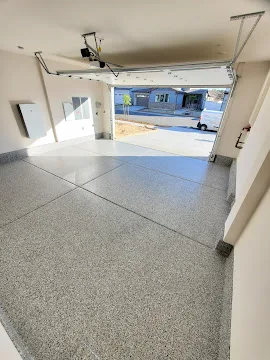
Garages are where this comparison gets asked the most, and for good reason: hot tires and dripped fluids are specific, repeated stresses that expose weak systems fast.
Hot-tire pickup is a coating problem, not a polished-concrete problem, because there’s no film to soften and lift. That sounds like an automatic win for polished concrete, but it isn’t the whole picture: oil still penetrates an unprotected polished surface, it just penetrates instead of peeling. Without a guard or sealer matched to the space, a polished garage floor will still stain from the same driveway leaks and quick-lube visits that stain anything else. Matching that guard or sealer to garage use is part of doing concrete polishing correctly, not an afterthought tacked on once the floor already looks stained.
Epoxy handles hot tires and oil differently, and it handles them well when the system is built correctly. The part that actually resists hot-tire pickup and holds up under UV coming through a garage door isn’t the epoxy base coat, it’s the topcoat over it. An aliphatic polyurethane or polyaspartic topcoat stays rigid under heat, so a hot tire releases cleanly instead of bonding to a softened film. Plain epoxy without that topcoat is a compromise in a real garage, not a finished system.
Inside the House, the Question Changes
Move the same comparison into a kitchen or a great room and the priorities that mattered in the garage mostly disappear, replaced by different ones: how the floor sounds underfoot, how it feels barefoot, whether the install disrupts the house, and what’s happening in the vapor coming up from the slab below a living space.
Polished concrete tends to fit interior living spaces well for reasons that have nothing to do with garages: it can be refinished later if the look needs updating, it doesn’t off-gas during a cure window the way a fresh coating does, and its hardness and reflectivity read as intentional in a home rather than industrial. It’s also loud, in the literal sense, hard and reflective surfaces carry sound differently than carpet or wood, which matters more in a house than a shop.
Epoxy indoors works well too, particularly where color and pattern matter more than a natural stone-like variation, but the install itself asks more of the household. Odor and cure time affect how soon a room comes back into use, and the chemistry cares about ambient conditions, temperature, humidity, dew point, in a way grinding and polishing simply doesn’t.
The Workshop Problem: Chemicals, Impact, and What You Can Actually Repair
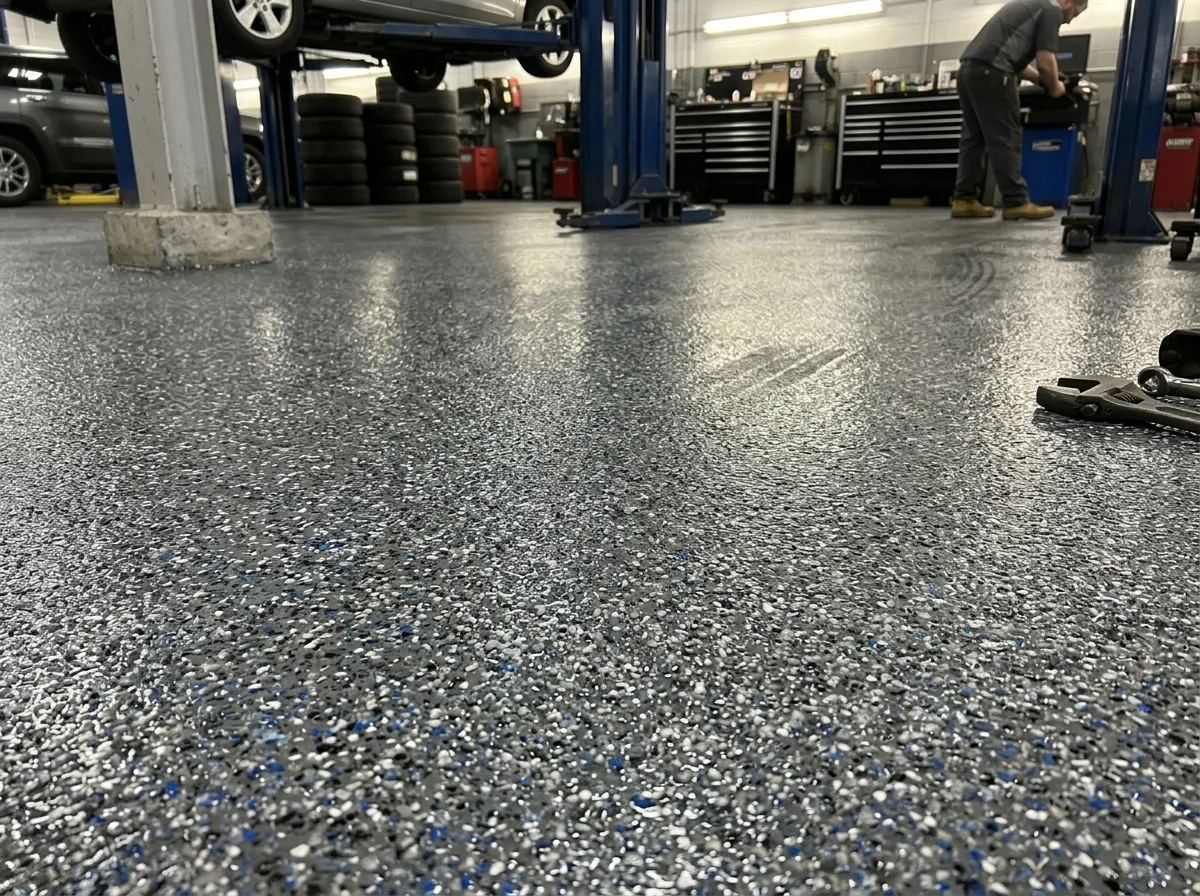
A workshop introduces a variable neither the garage nor the living-room comparison covers directly: chemical exposure from solvents, degreasers, and whatever else ends up on the floor during real use.
Epoxy’s chemical resistance is a genuine strength, and it’s formulation-dependent rather than automatic. The crosslink density of the cured resin controls how well it holds up to specific chemicals, which is why “epoxy resists chemicals” is true in general and imprecise in specific cases. It’s also why our epoxy flooring service starts with what the floor actually needs to resist before picking a system, not after.
Polished concrete doesn’t carry a chemical-resistance rating the way a coating does, because there’s no film chemistry involved. Reactive chemicals can etch or stain the refined surface directly. The repair path is different too: a damaged spot on a coated floor can sometimes be patched, while damage to a polished surface usually means re-honing that area, which is a different kind of job than a touch-up.
What’s Happening Under the Slab Changes the Whole Answer
This is the part of the comparison that gets skipped most often, and it shouldn’t be, because slab moisture doesn’t care which system you picked. It just fails each one differently.
A slab can test dry to the eye and still hold enough internal moisture to cause real problems. For epoxy, that moisture shows up as adhesion loss, and in worse cases, osmotic blistering, where trapped vapor pressure lifts the film from underneath. It can also show up as amine blush. That’s a waxy film that forms when curing epoxy reacts with moisture and carbon dioxide in cool, humid conditions, and it has to be removed before the next coat will actually bond. None of that is guesswork on a real job: proper testing (in-situ relative humidity probes, or a calcium chloride vapor emission test on bare concrete) tells you what’s actually happening in the slab before the resin goes down, not after.
Polished concrete doesn’t have a film to blister or delaminate, which is a real advantage, but “no film” doesn’t mean “no consequence.” The same underlying moisture shows up instead as efflorescence, white mineral deposits left behind as water carries salts to the surface and evaporates, as dye migration or uneven color if the floor was dyed, and as guard or sealer performance loss over time. Removing the visible salts without addressing the moisture behind them just brings the efflorescence back.
One point worth being precise about: there’s no single moisture number that applies across every system. The acceptable limit belongs to the specific primer or product being used, and a moisture-tolerant coating is not the same thing as a waterproofing system. If your slab sits over ground with no vapor retarder, or you’ve had irrigation or plumbing issues nearby, that’s worth raising before either system gets chosen, not after installation starts.
Living With It: Guard-and-Burnish vs. Recoat Cycles
The maintenance relationship is genuinely different between the two, and it’s worth thinking about before you pick, not after.
A polished floor lives on a routine of frequent dust mopping, occasional auto-scrubbing with a compatible cleaner, and periodic burnishing to bring the shine back in traffic lanes. Guard gets reapplied on a schedule, but there’s no coating thickness wearing away underneath it. The floor you polished is still the floor you have five years later, just needing its finish refreshed.
Epoxy and its topcoats live on a different clock. The topcoat is a sacrificial wear layer by design, which means it’s meant to wear down and get recoated before it wears through completely. Grit removal and prompt cleanup of oil or chemical spills matter for both systems, but epoxy adds chip and joint inspection to the routine, and a recoat that has to happen on a schedule rather than as an occasional touch-up.
What Neither One Can Hide
It’s worth saying plainly: neither system is a repair strategy on its own, and both will show you the truth about your existing slab in different ways.
Polished concrete hides almost nothing. Cracks, patches, and mismatched pours stay visible after polishing because polishing refines what’s there instead of covering it. If your slab has cosmetic damage you want gone, polishing will show it to you more clearly, not less.
Epoxy hides a bit more, a full flake or quartz broadcast can visually soften some surface inconsistency, but it’s not a fix for structural problems. Active cracks, unresolved moisture, and unsound concrete all need to be addressed before a coating goes down. A coating applied over an unresolved problem doesn’t solve it, it just delays when the problem becomes visible again.
When Polished Concrete Is the Wrong Answer
Polished concrete is the wrong call when the existing slab has real cosmetic damage you want gone rather than exposed, when you’re dealing with heavy oil or chemical staining that’s already happened and needs to disappear rather than just be protected going forward, or when you want a uniform color or a textured, non-slab look. Polishing works with the concrete you have. If what you have is inconsistent in a way you don’t want to see, polishing isn’t going to solve that for you.
When Epoxy Is the Wrong Answer
Epoxy is the wrong call when slab moisture hasn’t been tested and addressed, since skipping that step is one of the most common reasons coatings fail early. It’s also a mismatch if you want a system with no scheduled maintenance cycle at all, since even a well-installed topcoat has a wear life and a recoat schedule built in. And it’s the wrong direction if what you actually want is the look and feel of refined stone rather than a film’s smoother, more uniform surface. A hardware-store epoxy kit compounds all of this: thin, water-based product applied over a slab that was never properly ground almost never bonds well enough to last.
How to Actually Decide
None of this resolves to one universal answer, because it isn’t supposed to. A garage with hot tires and oil asks a different question than a kitchen floor, and a workshop with solvents asks a different one again. What actually decides it is the room, the use, and what’s happening in the slab underneath, not a general reputation either system has online.
If your situation points toward refining what you already have, whether that’s a garage, a great room, or anywhere in between, that path runs through concrete polishing: the inspection and grind sequence that decide how the existing slab actually finishes out. If it points toward a bonded, chemical-resistant, or color-driven system instead, epoxy flooring is built the same way in reverse, specified around how you’ll actually use the floor rather than applied as a generic kit.