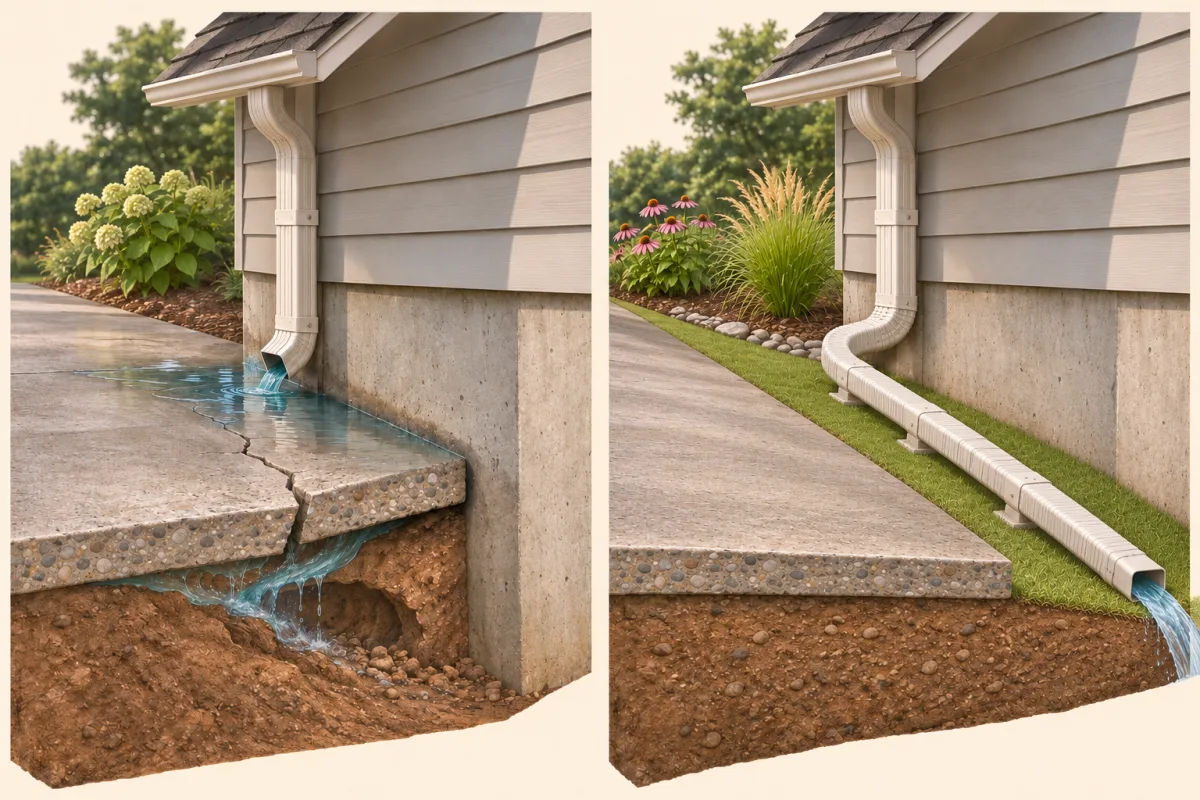
Concrete sinks after heavy rain because water gets under the slab and takes away the soil holding it up. Runoff from a downspout, a low spot, or an open crack drains into the base, softens it, and carries fine soil out from underneath. That leaves a hollow, and the slab settles into it. The fix is two parts: stop the water from reaching the base, then restore the support by lifting the sunken slab or repairing and replacing the broken section.
If one side of a crack is now higher than the other, or you can see a gap under a slab edge, the storms didn’t create a new problem. They showed you one that was already forming.
What’s happening under the slab
A driveway or walkway is only as solid as what it sits on. The concrete is hard, but hardness doesn’t help if the ground below it is gone. Every time water runs into a crack or joint, it moves a little sand and silt with it. Over a few wet seasons, that adds up to a pocket the slab can no longer bridge, and it drops.
Orange County adds a second problem. A lot of inland and hillside lots here sit on expansive clay. Clay swells when it’s soaked and shrinks back when it dries. A slab sitting on clay that gets soaked on one side (say, next to a downspout) and stays dry on the other gets pushed and dropped unevenly. That’s how you get one panel tilted toward the house while the panel next to it looks fine.
Signs your concrete is sinking, not just cracking
A plain crack is an opening. Sinking is a change in height. These are the signs that point to sinking:
- One side of a crack or joint sits higher than the other, enough to catch a toe or a wheel.
- Water now pools in a spot where it used to drain.
- A slab rocks or sounds hollow when you step on the edge.
- You can see a gap between the slab edge and the soil, or soil and sand washed out onto the surface after a storm.
- A walkway or patio is tilting toward the house instead of away from it.
That last one matters most. A slab that slopes toward your foundation sends every storm’s runoff straight at the house.
Pool decks are their own case. A deck that drops along the coping lets pool and rain water get under it, and the movement can crack the coping itself. That’s a job for pool deck restoration, where the deck, the joint at the coping, and the drainage get looked at together.
Fix the water first
Most of the sinking slabs we look at in OC have a water source sitting right next to them. A downspout that empties onto the driveway. A sprinkler head that soaks the same corner every morning. A planter bed that drains onto the walkway. A patio that lost its slope.
Before anyone lifts or replaces anything, that water needs somewhere else to go. Extend the downspout past the slab or tie it into a drain, aim sprinklers away from the edges, and seal the open cracks and joints so rain sits on top instead of draining through. A lift without the drainage change is a lift you’ll likely pay for twice.
Lift it or replace it
Once the water is handled, the slab itself has two realistic paths.
Lifting fills the hollow under the slab and raises it back toward level. We use polyjacking for this: small holes get drilled through the slab, and an expanding foam fills the void and lifts the panel. The holes get patched afterward. They stay visible, so ask to see what a patched hole looks like on concrete like yours. If you want them gone, resurfacing the concrete once the slab is stable puts one continuous surface over the lift holes and old repair lines. Lifting works best when the slab is still in one solid piece.
Replacement makes more sense when the slab is broken into chunks, cracked across in several directions, or sitting on a base that needs to be rebuilt anyway. It costs more disruption, but it lets you fix the base, the slope, and the joint layout all at once.
What doesn’t work is filling the gap flush with caulk or patching mortar and calling it fixed. The hollow underneath is still there. We cover that mistake in more detail in should you seal concrete cracks before it rains.
Not sure what you’re looking at?
Run your slab through our concrete crack checker. It asks five quick questions about the crack and what happens to it when it rains, and tells you whether it’s a watch-it, seal-it, or get-it-looked-at situation.
If it points to sinking, text us a few photos taken from the side so we can see the height difference. We’ll tell you whether it looks like a lift, a replacement, or a bigger repair before you spend anything.